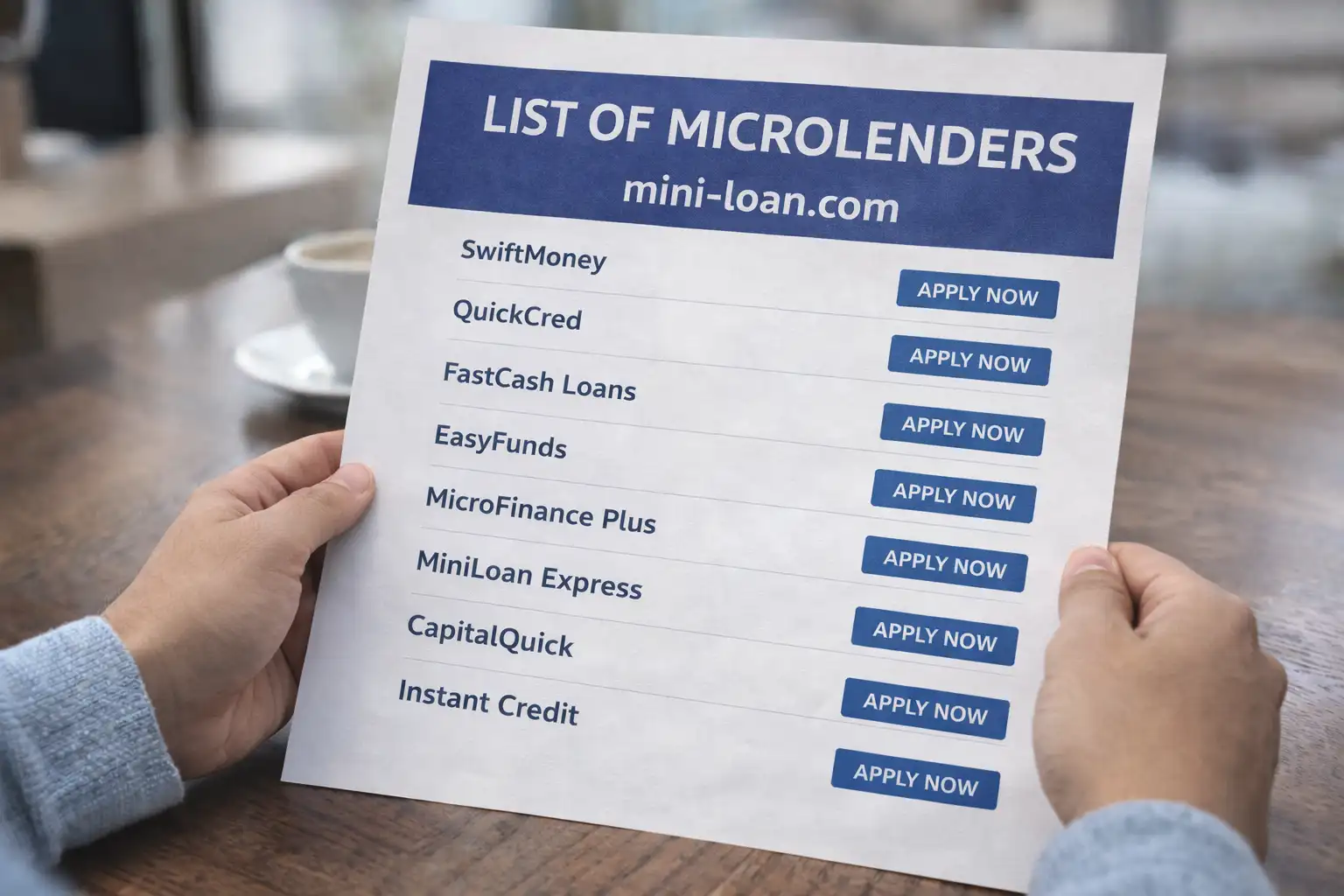
People often search for a ready-made list of small loan lenders, hoping to pick one and apply. The problem is that any fixed list goes out of date quickly: firms lose their authorisation, change their products, are bought out or are cloned by fraudsters using the same name. A list copied from a forum or an ad can lead straight to an unauthorised operator.
This page takes a different approach. Instead of naming firms, it sets out the categories of lenders that offer small amounts in the UK and the USA, what each one is usually good or bad at, and how to build and verify your own shortlist in a few minutes. Mini-pret.com does not lend, broker or rank lenders, and nothing here is a recommendation.
Why an official register beats any published list
In the UK, every firm that lends to consumers must be authorised by the Financial Conduct Authority. The FCA Financial Services Register is the definitive, up-to-date list: it shows whether a firm is authorised, which activities it may carry out, its registered address and its approved contact details. It also flags known clone firms. In the USA, lenders are mostly licensed state by state, so the equivalent check is the licence lookup of your state's financial regulator, alongside the complaint database run by the Consumer Financial Protection Bureau.
If a firm cannot be found on the relevant register, or the contact details do not match, it should not be on your list at all.
The main types of small loan lenders
Credit unions
Credit unions are member-owned cooperatives. In the UK, their interest rates are capped by law, and many offer small loans to members with modest incomes, sometimes linked to a savings habit. In the USA, federal credit unions can offer Payday Alternative Loans (PALs), small short-term loans whose APR is capped at 28%. The trade-off: you usually need to become a member first, and decisions can take a little longer.
High street and online banks
Banks offer personal loans and overdrafts, but the minimum loan amount is often higher than a true "mini" loan. Some US banks have introduced small-dollar loans for existing customers. An arranged overdraft can be convenient for very short needs, but compare its annual cost carefully.
Community development lenders
Community Development Finance Institutions (CDFIs) exist in both countries. They lend to people and small businesses that mainstream banks turn down, often at lower cost than high-cost short-term lenders, and some combine the loan with budgeting support. Our page on supported social microcredit covers this model.
High-cost short-term lenders
This is the category most "lender lists" really promote: payday and instalment lenders. In the UK they are subject to an FCA price cap, including a limit of 0.8% per day on interest and fees and a rule that you never repay more than twice what you borrowed. In the USA, rules vary sharply by state, and some states effectively prohibit payday lending. These loans are fast but expensive, and repeat borrowing is a well-known trap.
Buy now, pay later and retail credit
Point-of-sale instalment plans can spread a purchase without interest if every payment is made on time. Late fees and the ease of stacking several plans are the main risks.
Peer-to-peer and app-based lenders
Some platforms match borrowers with investors, and many lenders now operate mostly through an app. The legal status depends on the platform, so check it the same way. See our guides to peer-to-peer small loans and borrowing through a mobile app.
Lenders versus brokers and lead generators
Many websites that look like lenders are actually brokers or lead generators: they collect your details and pass them to several firms. This can trigger multiple searches, a flood of calls and messages, and in some cases a broker fee. In the UK, credit brokers must also be authorised by the FCA and must say clearly that they are a broker. Before you type your details anywhere, look for a statement of whether the site lends itself or introduces you to others.
Building your own shortlist: a checklist
- Start with your own bank and a local credit union, which already know you or serve your area.
- Note each firm's full legal name, then confirm it on the FCA Register (UK) or your state regulator's licence search (USA).
- Use only the website address and phone number listed on the register.
- Check whether the firm offers an eligibility check using a soft search, which does not affect your credit score.
- Compare the APR, the total amount repayable and the fees for the same sum and duration.
- Read recent complaints and how the firm handles them; in the UK, unresolved complaints can go to the Financial Ombudsman Service.
- Keep the list short: two or three serious candidates are enough.
To put numbers side by side, our small loan calculator guide shows how to work out instalments and total cost.
Warning signs of a fake lender
- A fee is requested before the loan is paid out, presented as insurance, admin or a "guarantee".
- Approval is promised regardless of your credit history or income.
- The offer arrives by social media message, text or a cold call.
- The firm name is close to, but not exactly the same as, an authorised firm.
- Payment is requested by gift card, cryptocurrency or transfer to a personal account.
Authorised lenders deduct their charges from the agreement itself; they do not ask for money first.
When a lender is not the right answer
If you need to borrow to pay for essentials, or to cover another debt, a new loan may only delay the problem. Free, independent advice is available from MoneyHelper and Citizens Advice in the UK, and from non-profit credit counselling agencies in the USA. They can help you prioritise bills, negotiate with creditors and check whether you qualify for grants, hardship funds or interest-free government advances. For more on the UK context, read about small loan rules in Britain; for the US picture, see small loan rules in the USA.
Offers and lenders to compare
- Find Your Credit Union — credit union or cooperative lender offering affordable small loans.
- Nationwide personal loans — bank offering personal loans; compare the APR and terms before signing.
- Santander UK personal loans — bank offering personal loans; compare the APR and terms before signing.
- Halifax loans — bank offering personal loans; compare the APR and terms before signing.
Indicative, non-exhaustive list of real institutions, with no commercial link to this site. Check authorisation, APR and terms before applying; never pay fees upfront.